
Classical & Operant Conditioning
Mechanisms of Behavioral Change
Every training program on the planet is driven by two behavioral systems: Classical & Operant Conditioning
Why does your mouth water when a microwave beeps? Because your nervous system does not distinguish between meaningful events and their predictors. It learns patterns, assigns emotional weight to cues, and adjusts your behavior accordingly, all without consulting you first. Two mechanisms drive this process: classical conditioning and operant conditioning. One governs what you feel. The other governs what you do.
What is Classical Conditioning?
The governing principle is simple. When a neutral stimulus (object or event that produces no response) is repeatedly paired with one that already triggers a response, the neutral stimulus acquires the ability to trigger that response on its own. The brain builds a shortcut. The shortcut becomes automatic.
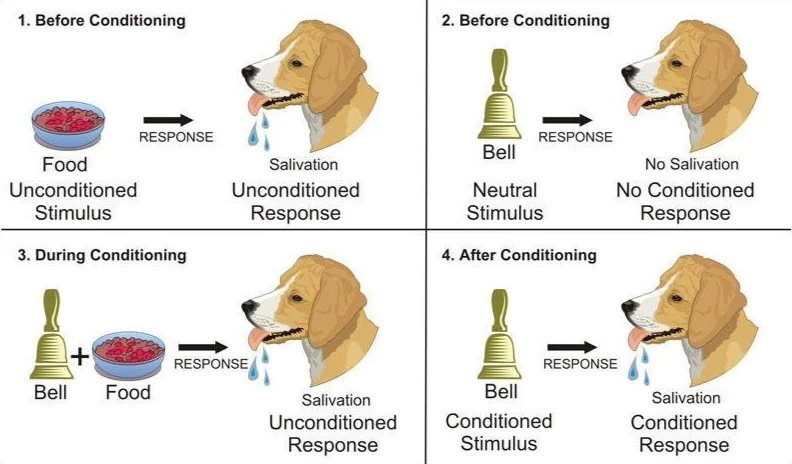
Ivan Pavlov identified this mechanism in the 1890s while studying digestion in dogs. The animals began salivating not at food, but at the sound of footsteps approaching the lab. Four terms define the system.
The Unconditioned Stimulus (US) is whatever naturally triggers a response, in this case food. The unconditioned response (UR) is that automatic reaction, salivation.
The Conditioned Stimulus (CS) is the formerly neutral cue that, through repeated pairing, begins triggering the response alone. Pavlov used a bell. The Conditioned Response (CR) is the learned reaction to that cue: salivation at the bell, no food required.
Pair a Neutral Stimulus (NS), the bell, with a meaningful one (food) often enough, and the NS inherits the power of the original.
Where This Shows Up
Your phone's notification sound has no inherent meaning. It is a short arbitrary tone. But it has been paired thousands of times with messages, social validation, and novelty. Now the sound alone produces a spike of anticipation, or anxiety, before you have any idea what the notification contains. You are Pavlov's dog. The phone is the bell.
A specific cologne can trigger heartache years after a relationship ends. The scent, chemically unremarkable, became a CS paired with the emotional weight of another person. Advertising works the same mechanism with surgical intent: car commercials do not sell vehicles. They pair vehicles with mountain roads, attractive people, and evocative soundtracks until the brand alone carries that emotional charge.
Key Terms
Extinction is what happens when the CS appears repeatedly without the US. The association erodes. If your phone buzzed for weeks and never delivered anything worth reading, you would eventually stop reaching for it.
Generalization is the tendency for stimuli similar to the CS to trigger the same response. A child bitten by a German Shepherd may develop a fear of all large dogs. The system errs on the side of caution.
What Is Operant Conditioning?
Operant conditioning is a learning theory built on a simple idea: animals (and people) learn by doing, and by experiencing the consequences of what they do. Psychologist Edward Thorndike was the first to describe this formally, noting that behaviors followed by satisfying outcomes tend to be repeated, while those followed by discomfort tend to stop. B.F. Skinner later expanded this into a complete framework — one that modern dog trainers, behaviorists, and educators still use today. The key word is operant — meaning the learner is operating on their environment. They’re not just reacting to a stimulus (that’s classical conditioning). They’re making choices, and learning from what happens next.
In short: behavior is shaped by its consequences.
The Four Quadrants & How Behavior Gets Steered
Operant conditioning gives us four tools for influencing behavior. These are often called the four quadrants, and each one works differently. The terms can sound technical at first, but the concepts are very intuitive. The two core terms to understand first:
Positive = adding something to the situation
Negative = removing something from the situation
Reinforcement = makes a behavior more likely to happen again
Punishment = makes a behavior less likely to happen again
Now let’s walk through each one.
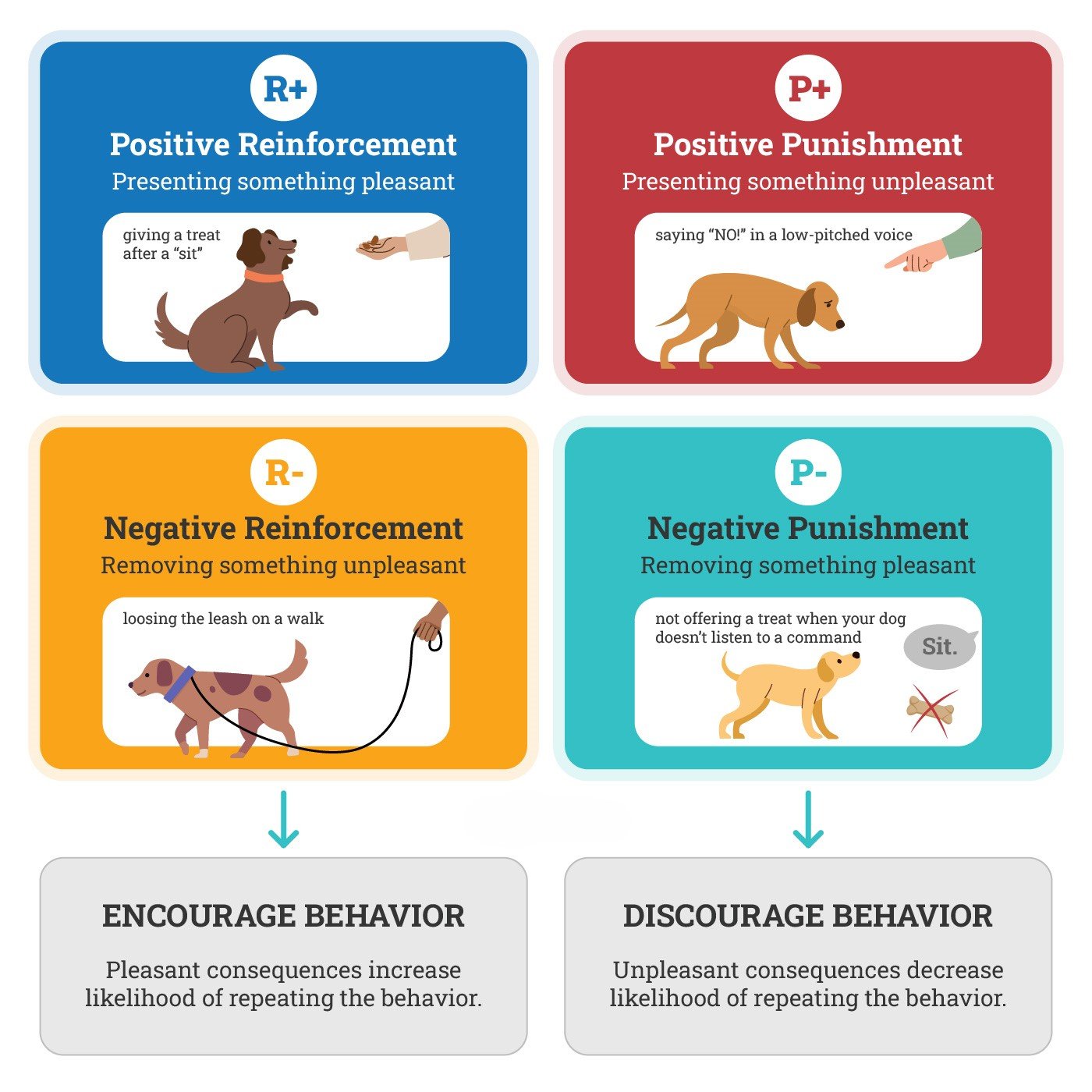
The Four Quadrants & How Behavior Gets Steered
1. Positive Reinforcement (+R)
Add something good → behavior increases
This is the most recognized quadrant — for good reason. You add something the dog values (food, praise, play, access) immediately after a desired behavior, so the dog learns to repeat it.
Example: Your dog sits when asked. You give them a treat. They sit more readily in the future because sitting pays off.
Positive reinforcement is the foundation of reward-based training. It creates enthusiasm, confidence, and a dog eager to work with you.
2. Negative Reinforcement (-R)
Remove something unpleasant → behavior increases
“Negative” doesn’t mean bad, it means removal. You remove something the dog dislikes, so the behavior that caused that removal increases.
Example: You apply gentle leash pressure while teaching a dog to walk close to you. The moment the dog moves into the correct position, the pressure is released. The dog learns that moving into position removes the discomfort, so they do it more.
Negative reinforcement, when applied properly, is a legitimate, effective tool for building position, focus, and directional control.
3. Positive Punishment (+P)
Add something unpleasant → behavior decreases
Again, “positive” just means adding. You add a consequence the dog finds unpleasant immediately following an unwanted behavior, with the goal of reducing it.
Example: Touch a hot stove, experience pain, stop touching stoves.
See “A Note On Balance” below for more
4. Negative Punishment (-P)
Remove something good → behavior decreases
You take away something the dog wants in response to an unwanted behavior, making that behavior less likely.
Example: When your dog jumps to greet you, turn away and walk off. They learn jumping ends interaction and will stop.
Negative punishment is a low-pressure, effective tool for attention-seeking. It requires consistency. If one person ignores jumping while another rewards it, the behavior persists.
The Bigger Picture: What All Four Have in Common
Every behavior your dog performs is either being reinforced (made stronger) or punished (made weaker) even when you’re not aware of it. The environment itself is constantly providing feedback. That’s why unintentional reinforcement is so common: a dog jumps up, you push them off while making eye contact and talking to them, and you’ve just delivered attention, the very thing they wanted. Understanding the quadrants gives you the ability to be intentional about the feedback your dog receives. You stop accidentally reinforcing behavior you don’t want, and start consistently reinforcing the behavior you do.
A Note On Balance
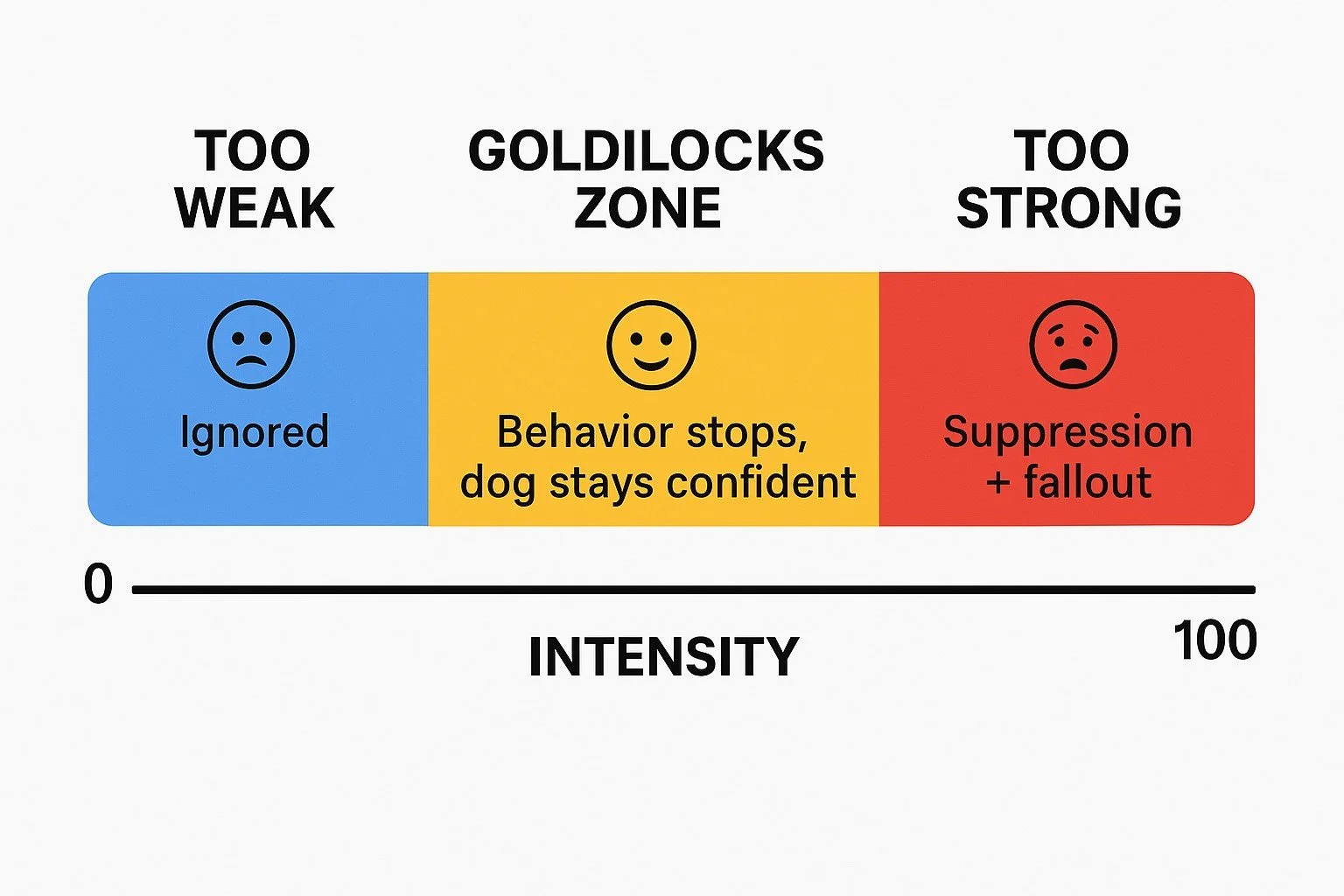
No single quadrant tells the whole story. Effective training uses all four weighted differently depending on the dog, the behavior, and the context. A working police dog and a family companion are both learning through the same principles, but the application differs significantly.
What matters most is that consequences are:
Timely — delivered within one second of the behavior.
Consistent — the same behavior produces the same outcome.
Appropriate — calibrated to the individual dog’s temperament and sensitivity.
Fair — only applied when the dog genuinely understands what was expected.
Reinforcement builds behavior. Consequences define its limits. Together, they give a dog the full picture . Not just what to do, but what not to do. That combination is what creates a dog who is not just obedient, but genuinely well-mannered.
A Neuroscience View
Reinforcement uses dopamine prediction-error circuits in areas like the striatum. If an outcome is better than expected, dopamine spikes and the behavior is reinforced.
Punishment and aversive learning use shared brain circuits, including the amygdala, which marks events as threats to avoid.
This chart can be thought of like a control panel for behavior probability. You are adjusting inputs, watching behavior outputs, and tuning the system.
Many trainers obsess over the quadrant they believe they are using. The dog only experiences the quadrant that actually changes its behavior. A trainer may think they are doing reinforcement, but if the dog’s behavior decreases, the brain classified it as punishment. The nervous system is the final judge. Behavior science has a ruthless rule: the organism defines the contingency (the rule that links a behavior to its consequence.).
Example: Dog jumps on guest → attention stops.
The contingency is: Jumping - loss of attention
If that pattern happens consistently, the dog’s brain starts updating the probability of jumping. In other words, learning is basically the nervous system running millions of tiny experiments: If I do X… what happens next? Once the pattern stabilizes, the contingency has been learned.
That simple rule explains about 80% of why humans argue about training methods.
The Trainer’s Role
The science only works when it’s applied with patience, clarity, and consistency. A dog who fails to learn a lesson isn’t a stubborn dog — it’s feedback that something in the communication broke down. The question a skilled trainer always asks first is: Where am I at fault?
When both trainer and dog understand the rules, and consequences are delivered fairly and without emotion, learning accelerates. The dog becomes a willing, confident participant, not because they’re forced to be, but because the system makes sense to them. That’s the power of operant conditioning. It doesn’t override a dog’s nature. It works with it.
The Practical Implication
You are being conditioned constantly, by your environment, your devices, your own behavioral patterns. The question is not whether these mechanisms are operating on you. They are. The question is whether you understand them well enough to notice when they work against your interests and to design conditions that harness them in your favor.
Pavlov's dogs did not choose to salivate at a bell.
