
The Hidden Cost of Ideology in Dog Training
How did we go from choke chains to chicken? And more importantly, how did a correction that was once considered routine become synonymous with abuse? The answer is not complicated, but it requires honesty: the dog training profession experienced a cultural overcorrection. We moved from one extreme to another, and the dogs caught in the middle are the ones paying for it.
To understand where we are today, we need to trace how we got here. Not as a history lesson for its own sake, but because the assumptions trainers and owners carry into a session are products of this cultural arc and many of those assumptions are incomplete.
The Old World: Compulsion and the Alpha Myth
For most of the 20th century, dog training operated on a single principle: control. The prevailing theory held that dogs were pack animals governed by a rigid social hierarchy, and the owner’s job was to establish dominance as the “alpha.” The tools reflected the theory of choke chains, prong collars, alpha rolls, and corrections that relied on physical force and intimidation.
Dogs who did not comply were labeled “dominant,” “stubborn,” or “willfully disobedient,” and the prescribed response was always the same: more pressure. Think of it as a volume knob with only one direction. The dog does not respond, so you turn it up. He still does not respond, so you turn it up again. The possibility that the signal itself is the problem never enters the equation.
There was a kernel of truth buried in this framework. Structure, consistency, and clear leadership do matter in a dog’s life. But the science underpinning the rest of it was flawed from the start. The wolf pack studies it drew from were later largely discredited — they were conducted on unrelated wolves in captivity, producing abnormal social dynamics with no meaningful parallel to domestic dogs living in human households.
The result was a generation of dogs trained through fear and suppression. Some performed beautifully, compliance through intimidation can produce results. But the emotional cost was real, and the methodology left no room for nuance, individual temperament, or the dog as a thinking, feeling creature with its own internal experience.
The Revolution: Positive Reinforcement and the Science of Learning
In the 1980s and 1990s, the field shifted. Behaviorism, the formal science of how behavior is shaped by consequences migrated from research labs into training facilities. Karen Pryor’s work with marine mammals brought clicker training to mainstream awareness. Ian Dunbar pioneered puppy socialization and reward-based obedience. A new generation of trainers discovered that force was not a prerequisite for building behavior. What you needed was food, timing, and an understanding of how learning actually works.
The results were striking. Dogs could be trained with enthusiasm rather than fear. The relationship between dog and owner shifted from compliance to partnership. Positive reinforcement, the process of strengthening behavior by following it with a desirable outcome, builds behavior faster, more reliably, and with greater generalization than compulsion alone. The science is clear on this, and the training world was right to embrace it.
But movements, once they gain momentum, rarely stop at the sensible middle.
The Overcorrection: When Science Became Dogma
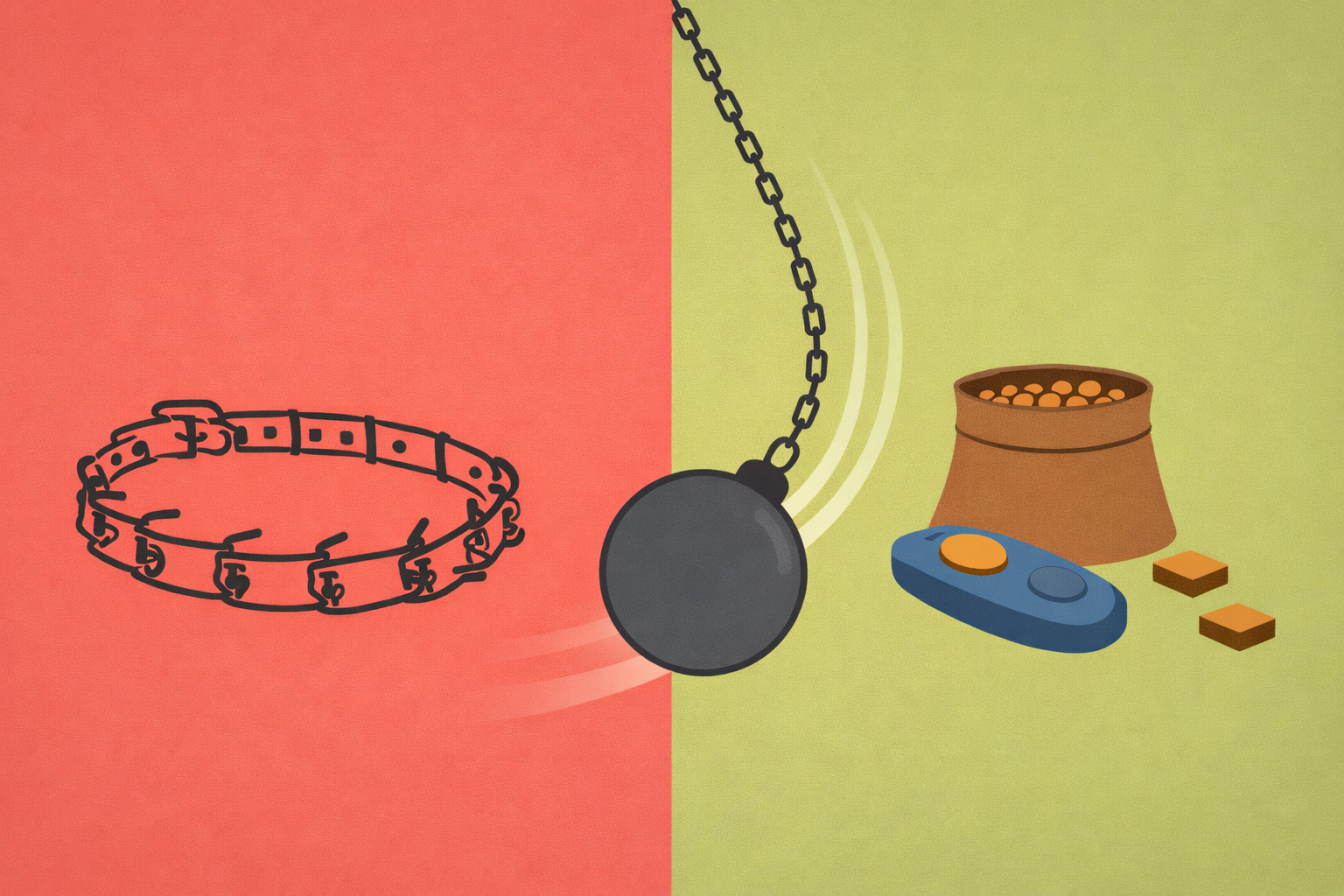
By the 2000s, the positive reinforcement movement had evolved from a methodology into an ideology. The phrase “purely positive” entered the training lexicon, and with it, a set of beliefs that went well beyond what the science actually supported.
The argument, stated plainly: because positive reinforcement is effective and humane, and because aversive methods cause harm, the ethical trainer uses only positive reinforcement. Any correction, any consequence, any aversive of any kind was not just unnecessary but cruel. The label “balanced trainer”, meaning someone who uses both reinforcement and consequences, became something to defend rather than describe. “Punishment trainer” became a slur.
This is where the cultural shift became a problem. Because here is what the science actually says: operant conditioning, the framework governing how behavior is modified through consequences, has four quadrants, not two. All four are documented. All four occur in every dog’s life whether a trainer uses them intentionally or not.
The dog who jumps on the counter and finds food is receiving positive reinforcement for that behavior. The dog who barks at the mailman until he leaves is receiving negative reinforcement, the perceived threat has been removed, and the barking is strengthened. These are not training choices. They are facts of behavioral science operating in real time, with or without your input.
A training philosophy that refuses to acknowledge two of the four quadrants does not have more integrity. It has less situational awareness. That is not a matter of opinion. It is a structural limitation.
What the Overcorrection Produced
The consequences of this ideological shift have been accumulating for years. They show up in predictable patterns, and I have seen each of them repeatedly throughout my career.
The permissive dog. A dog raised on rewards alone, where no behavior ever receives a clear consequence, learns one side of the equation and not the other. He knows what earns a treat. He has no meaningful understanding of what is genuinely unacceptable. In the absence of that information, he writes his own rules, not out of malice, but because a system with no boundaries is a system waiting to be self-organized. This produces the dog that countersurfs, jumps on every guest, bolts through every door, and ignores the recall when something more interesting appears. Not a bad dog. An uneducated one.
The learned helplessness misdiagnosis. Learned helplessness is a real and serious condition in which an animal exposed to inescapable aversives gives up trying to influence its environment. It became a catch-all accusation leveled at any trainer who used consequences. The distinction between traumatic, inescapable aversives and a well-timed, proportionate consequence delivered after the dog understood the expectation got completely lost. There is a stark difference between those two things. One is abuse. The other is communication.
The elevation of management over education. Baby gates, leashes, crates, and redirections became the default response to any unwanted behavior in purely positive circles. Management is valuable, it is an essential part of any training program. But management is not training. Think of it as the difference between a guardrail and a driving lesson. A guardrail prevents the car from going off the cliff. It does not teach the driver how to steer. The moment the guardrail is removed, the underlying problem is still there. A dog who has never been in the kitchen unsupervised is not the same animal as a dog who understands that counter surfing has a cost.
The social media effect. The rise of dog training content on YouTube, Instagram, and TikTok poured accelerant on all of this. Emotionally compelling clips of dogs being corrected spread rapidly through communities already primed to view any correction as cruelty. The algorithm rewards outrage. Nuance does not trend. The result is a training culture increasingly shaped by viral content and tribal affiliation rather than science, experienced mentorship, or the actual outcomes of the dogs.
The Real Cost
The dogs who pay for this cultural moment are rarely the ones in training videos. They are the ones in shelters.
Surrender rates for young dogs, between one and three years old remain stubbornly high. The most common reasons cited by owners: jumping, pulling on leash, reactivity, disobedience, and general unmanageability. These are all behaviors that respond well to balanced training. They are also all behaviors that, without meaningful consequences, are reinforced constantly by the environment and by the dog’s own experience.
A dog who has never been taught that jumping has a cost, who has never had a recall made truly non-negotiable, who has never been shown that counter surfing produces an undesirable outcome that dog is difficult to live with. And a dog that is difficult to live with is a dog at risk of losing his home.
The irony is not subtle. A movement that set out to protect dogs from harm has, in practice, contributed to outcomes that put dogs at greater risk of abandonment. I have watched this pattern repeat itself for years.
What Balance Actually Looks Like
It is worth being precise here, because “balanced training” has acquired political baggage that obscures what it actually means in practice.
A balanced approach does not mean using punishment freely or defaulting to corrections when patience would serve better. It means understanding all four quadrants of operant conditioning and deploying them appropriately, based on the individual dog, the specific behavior, and the stage of learning. Simply: the right tool at the right time for the right dog.
The sequence matters enormously. A consequence is only appropriate when the dog has been clearly and repeatedly taught what was expected, the dog has demonstrated genuine understanding of the behavior, the consequence is proportionate to the individual dog’s temperament, and it is delivered within one second of the behavior, calmly and without emotion.
What this rules out is most of what gave the old compulsion-based era its bad reputation: correcting dogs who did not understand, correcting out of frustration, and using consequences as a substitute for teaching. A well-timed, appropriate correction delivered after genuine understanding is not trauma. It is the completion of an education.
I define it plainly in my own practice: obedience training is the result of establishing clear lines of communication and social boundaries, by selectively and consistently applying incentives and appropriate deterrents to guide and shape behavior. Incentives and deterrents. Both. Not one or the other.
The Trainer’s Responsibility
What the best trainers in this field share regardless of which tools they prefer, is an ethos built on the dog’s actual experience, not their own ideological comfort.
That means delivering rewards and consequences with fairness and consistency, never out of anger or frustration, but as considered decisions aimed at changing behavior. It means adjusting the approach to fit the dog in front of you, not forcing the dog to fit the approach. And it means asking the question that separates competent trainers from everyone else: when a dog fails to understand, when progress stalls, when a behavior persists, where am I at fault?
That question is the marker of a trainer who is actually on the dog’s side.
Where We Go From Here
The cultural pendulum is showing early signs of correction. More trainers are openly advocating for balance. The “purely positive” label is being scrutinized with more rigor. Clients who tried purely positive approaches and watched their dogs become increasingly unmanageable are seeking out trainers who will give them the full picture, devoid of ideology.
The goal is not to return to the choke chain era. No one with any understanding of behavioral science is arguing for that. The goal is to stop pretending that a complete education can be built on half the available tools.
A dog who has never been told “no” is not the same as a dog who has been treated kindly. Those are not interchangeable statements. And the difference between them matters enormously to the dogs who deserve the full education.
Imagine a child who has never been told “no.” That child isn’t experiencing kindness. They’re experiencing a lack of guidance. The world becomes confusing because boundaries suddenly appear later, at school, other people’s homes, society, and the child hasn’t learned how to navigate them.
A dog can be treated with patience, respect, and compassion while still being clearly told, “that behavior doesn’t work.” In fact, that clarity often reduces anxiety, because the dog finally understands the rules of the game.
Paradoxically, the dogs that seem “out of control but sweet” are often the ones who have been least guided, not the ones who have been treated most kindly. The brain (human or canine) likes rules. Predictable systems lower cognitive load.
The strange twist is that structure, when done well, actually feels more compassionate to the animal than endless permissiveness. Chaos looks gentle on the surface but is internally messy underneath. And there lies the most common root of behavioral problems in dogs.
